
Allegheny County Release Meanings
A person is released from Allegheny County Jail only when valid authority permits the jail to end that custody. Even then, the destination matters. The person may leave for personal custody, treatment, electronic monitoring, probation, or another supervised setting. A move to Renewal, Passages to Recovery, a Pennsylvania state institution, federal custody, or another county ends a stay in the jail building but does not prove freedom from custody or control.
The jail's population system holds admission, processing, and releasing records. A court docket may show the bond, sentence, dismissal, or other disposition that supplied legal authority. Pennsylvania DOC, BOP, ICE, VINE, and supervision offices cover different custody classes. The strongest conclusion joins the authority event to an agency-confirmed physical exit instead of treating a missing current-roster name as proof.
- Discharge
- The end of custody or supervision recorded by the responsible agency.
- Time served
- A sentence satisfied with credit for custody already completed.
- Parole
- Conditional release from a prison sentence before its maximum date.
- Probation
- Court-ordered community supervision that may follow or replace confinement.
Allegheny County Release Types
No single label explains every departure from ACJ. A court-authorized exit can follow bond, dismissal, a sentence of time served, probation, or completion of a county term. Other movements include treatment diversion, electronic monitoring, alternative housing, transfer to Pennsylvania DOC, transfer to a federal or other county authority, and an immigration-related handoff supported by lawful authority. Policy 219 describes record categories, not a public schema, so request a type or destination only if maintained.
| Exit or movement | Meaning | Best next check |
|---|---|---|
| Bond or court release | Authority to begin discharge after charges and holds clear | ACJ exit confirmation and UJS docket |
| Time served or dismissal | The controlling county case may end | ACJ record and court disposition |
| Probation or parole | Physical custody ends while supervision may continue | Adult Probation or PA DOC parole office |
| Alternative housing | A controlled county placement outside ACJ | ACJ, court, and placement authority |
| State or federal transfer | Another authority takes control | PA DOC or BOP locator |
Allegheny County Release Record Fields
Allegheny County does not publish one universal release certificate. ACJ Policy 219 says the population system maintains admission, processing, and releasing records. Custody files can also include booking information, court background, dispositions, cash, and property receipts. A narrow request should seek the existing booking-and-release entry. It should not assume each file contains identical labels or that every field is public.
| Requested field | What it can establish |
|---|---|
| Name and booking identifier | Connects the answer to the correct jail stay |
| Admission date | Identifies the custody episode |
| Actual exit date and time | Shows when ACJ custody ended, if maintained |
| Release type or reason | Distinguishes a community exit from another outcome |
| Destination or transfer agency | Shows whether another authority followed |
| Property and cash receipt | Documents items or funds handled at discharge |
A phone answer is useful but not certified. Call ACJ at 412-350-2000 and ask when the person left and whether it was release or transfer. Former incarcerated people may call the Records Office at 412-350-2635 for their records.
Request Allegheny County Release Records
The Allegheny County Open Records office accepts requests online and through its form by email, fax, mail, or in person. The custodian is Jessica Garofolo, Open Records Officer, County Office Building, 542 Forbes Avenue, Room 101-Mezzanine, Pittsburgh, PA 15219. Contact channels are openrecords@alleghenycounty.us, 412-350-6109, and fax 412-350-4925.
- Identify one person and one booking, adding a known date of birth or booking number.
- Give an approximate date range and name Allegheny County Jail.
- Ask for the existing admission or releasing entry, including exit date, time, type, and destination if maintained.
- Request electronic delivery and do not ask staff to create a new list.
- Review any redactions, denial grounds, extension date, and appeal directions.
The county must generally grant access, deny or partly deny with grounds, or issue a proper extension notice within five business days. County-listed paper copies cost $0.25 per page or side, certification costs $1, and permitted postage or reproduction charges can apply. Electronic delivery normally adds no delivery fee. Prepayment may be required when an estimate exceeds $100.
Allegheny County Release Record Law
Pennsylvania's Right-to-Know Law, 65 P.S. §§67.101 and following, supplies the process for local-agency records. Section 901 sets the initial response period, Section 902 governs extensions, and Section 708 contains exemptions. The law does not make an agency create a record and does not set a universal retention term. No public retention period for an ACJ released-person entry was located.
Court files follow the Unified Judicial System's public-access policy. Pennsylvania's definition of disposition in 18 Pa.C.S. §9102 includes dismissal, conviction, pardon, commutation, and discharge from probation, parole, or correctional supervision. A docket can show legal authority, but it is not a live jail exit log.
Allegheny Releases After Expungement
An Allegheny expungement requires a motion and a Common Pleas order. The local process lists such paths as nonconvictions, ARD, probation without verdict, and qualifying summary matters. After an order, the Department of Court Records says it removes responsive nonconviction data and notifies offices including ACJ, the Sheriff, Adult Probation, Pennsylvania State Police, the District Attorney, and the arresting agency.
Implementation may take up to one year. Official systems can disagree during that period. Later absence from UJS may reflect expungement or Clean Slate limited access rather than proof that no booking or release occurred. Search conclusions must respect the current public status without inventing a history from an empty result.
Allegheny County Bond Release Timing
Bond payment authorizes processing, but it does not prove that the person has left. During business hours, the Bond Counter operates in Room 114 of the County Courthouse. The county lists a $50 filing fee and accepts exact cash, money order, or cashier's check. After hours, weekends, and holidays, payment moves to the Municipal Courts Building at 660 First Avenue.
Once ACJ receives the necessary documents, the jail describes release as typically occurring within three hours. Staff must still close or lift all charges and holds. A bond docket entry and an actual jail exit can carry different times without conflict: the court entry proves authority, while the jail answer or release record proves the physical event.
Allegheny County Release Counts
The 2024 Warden's Report recorded 8,672 releases, including 5,579 to personal custody. These are administrative events, not necessarily unique people. Its 18.3-hour average covered a defined personal-custody DRC workflow and excluded 873 cases, including some alternative-housing and electronic-monitoring situations.
None of these figures predicts an individual's exit. The period, denominator, and exclusions remain part of the fact. A named release requires person-specific confirmation.
Allegheny Release Property and Support
The Discharge and Release Center on Level 1 handles concrete parts of a personal-custody exit. Staff may return property and funds, provide suitable clothing, offer medication or prescription and follow-up information, supply NARCAN, make referrals, and issue an incarceration-verification letter. Excess funds can be returned partly in cash and partly by check.
DRC hours are Monday through Friday from 8 a.m. to 8 p.m. and Saturday from 8 a.m. to 4 p.m.; it closes on Sundays and holidays. Those are service-center hours, not proof that legal releases stop when services close. The coordinator number is 412-350-2231.
Find Allegheny County Released Inmates
A released person normally falls out of the jail's current-person view. That does not establish where the person went. Allegheny County publishes no official named 24-hour or 72-hour released-person feed found in the current county pages, so the search begins with identity and custody class.
- Collect the full name, known date of birth, booking date, arresting agency, and any booking or docket number.
- Call ACJ at 412-350-2000 and ask when the person left and whether it was release or transfer.
- Use Pennsylvania UJS Case Search for the order, bond, sentence, or disposition.
- Check PA SAVIN/VINELink and read release and transfer as different events.
- If ACJ names state, federal, or immigration custody, continue with PA DOC, BOP, or ICE.
- Request the existing ACJ releasing entry when documentary proof is needed.
Allegheny Released Inmate DOC Search
The Pennsylvania DOC locator covers state inmates and department-supervised people, not county-only stays. Search by inmate or parole number when possible, then compare name, date of birth, current location, and identifiers. A person released from an SCI to state parole may remain visible on the supervised-person side.
| Field | Use |
|---|---|
| Inmate or parole number | Best match key when available |
| Name and identity filters | Find candidates, then compare date of birth |
| Current location | Shows the system's reported placement |
| Release Date | The verified public prison-exit label |
| Available image | An identity aid, not proof by itself |
The verified label is “Release Date.” Research did not confirm a Pennsylvania locator label called “Projected/Tentative Release Date” or a status literally called “Released/Discharged.” A Release Date plus a parole number can support departure from state prison into supervision. It does not prove the entire sentence ended.
The official locator interface shows the fields used for an Allegheny County state-custody search.
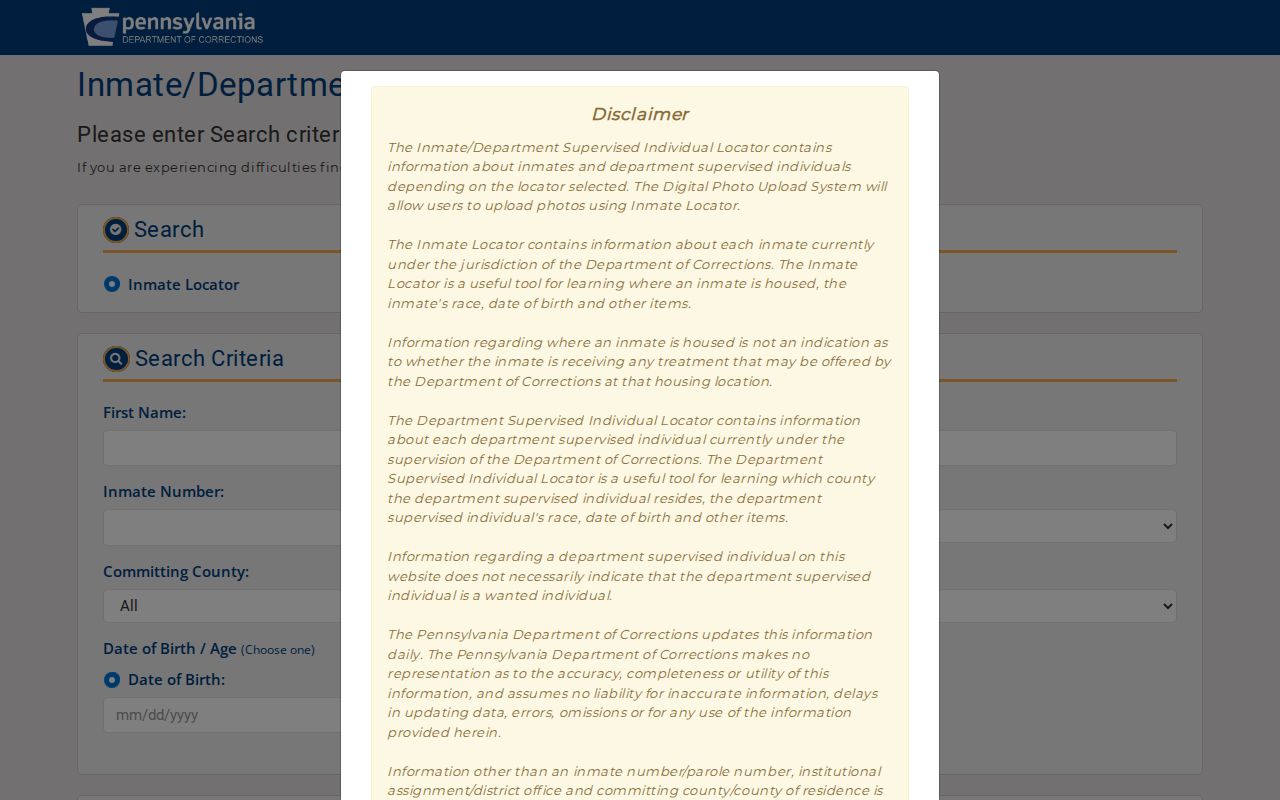
The image confirms the state channel, while county-only release records remain with ACJ.
Allegheny County Recent Release Search
No official Allegheny County named recent-release roster, sheriff release app, or public archive window was located. The jail publishes current-person services, daily aggregate population, and release-process guidance instead. “Released in the last 24 hours” describes a desired date range, not a county product. A focused record can prove that one person left within a range; daily totals cannot identify names.
The county's 48-hour rule is not a feed-retention window. Ordinary discharge may take up to 48 hours beginning at midnight on the order date. Bond has a separate estimate. The Released Last 24 Hours route starts with ACJ confirmation rather than an invented list.
Allegheny Release Court File Search
UJS can show docket entries, calendar events, disposition, sentence, and financial entries after a person leaves the operational jail view. For local paper files, the current year and four prior years of Allegheny criminal files are immediately available in courthouse Room 220. Older files must be ordered from storage, and public terminals are available.
Staff answer file-order questions at 412-350-5320 but do not give case-specific facts by telephone. The Criminal Division is at 436 Grant Street, Room 114, Pittsburgh, with weekday public hours from 8:30 a.m. to 4:30 p.m. This durable court path can explain release authority, but ACJ remains the source for its actual exit event.
Allegheny Post-Release Supervision Check
Pennsylvania has two relevant supervision tracks. The Pennsylvania Parole Board decides state parole, while PA DOC field staff supervise people released from state incarceration. Allegheny Adult Probation handles county cases. No public county person-name probation database was identified, so the official office is the proper route.
State supervision may appear in the DOC locator. County questions go to Adult Probation at 412-350-2320. The state absconder database covers only supervised people alleged to have stopped reporting; it does not show a present location or prove discharge. Office details appear on the Parole / Probation page.
Allegheny Release Alerts and Federal Records
PA SAVIN/VINELink covers Allegheny County jail, Pennsylvania state prison, and state parole feeds. It can send notice of release, escape, movement, or transfer. Read the event label. A transfer is not community release, and VINE is not a certified court or release record. Federal custody sits outside VINE's controlling coverage.
For a federal sentence, the BOP Inmate Locator shows a release date and location. A past date with no institution, or a location of “RELEASED,” reports the end of BOP custody. A future date is projected. ICE ODLS covers current detainees and some releases in the prior 60 days, but a negative result is not release proof.
Allegheny Release and ICE Detainers
ACJ Policy 220 creates a key local distinction. A civil DHS Form I-247 detainer or I-200 administrative warrant alone does not authorize ACJ to delay an otherwise approved release and does not impede bond. A judicially signed warrant is different. The forms are stored in the person's file rather than the offender-management system.
A roster entry or basic releasing record may not resolve an ICE question. Request the relevant form when it is material and publicly available, or use the ICE channel. Report a transfer to ICE only when an agency confirms it. Release from county custody and release from immigration custody are separate events.
Allegheny Released Versus In Custody
The right system depends on both the former custodian and the event being proved. Current-custody interfaces answer who is held now. Release records answer when one custody ended. Court files explain legal authority, while supervision records show control after physical release.
| Situation | Source | What it proves |
|---|---|---|
| Currently at ACJ | ACJ information or jail phone | Present county custody |
| Left ACJ | ACJ phone and releasing record | Exit and destination, if maintained |
| State prison or parole | PA DOC locator and office | State location, Release Date, or supervision |
| Federal sentence | BOP locator | BOP location and reported date |
| Court authority | UJS and court records | Order, sentence, or disposition |
Getting Home After Allegheny Release
Before a personal-custody exit, a person may use the DRC to call and arrange transportation. The county may provide a bus or light-rail ticket. September 2025 data recorded 319 passes, with 292 from DRC and 27 from Intake. A county footnote says Intake passes can include some transfers, so that number is not a count of community releases.
Transportation support does not determine legal status. A ticket may accompany a personal release, while another move can end at a controlled destination. The custody record and named destination remain the proof. Transit, clothing, medication, property, and verification services describe what can happen around the exit, not whether all supervision ended.
Allegheny County Release Clock
Allegheny County uses two distinct process descriptions. For ordinary court-authorized discharge, ACJ says it has up to 48 hours beginning at midnight on the date the order is sent. For bond, the jail says a person is typically released within three hours after it receives the required documents. Neither period is a public-list window or a guaranteed appointment.
DRC service hours do not define the legal release clock. A court order can exist while charges or holds remain under review, and a weekend or holiday can affect service availability without proving that release processing stopped. Ask ACJ for the physical exit instead of estimating it from the order date.
Allegheny County Release Facilities
Allegheny County Jail is the adult county hub. Renewal and Passages are county alternative housing. Pittsburgh CCC, CTC Braddock, Renewal #1, and Renewal #2 are Pennsylvania DOC community corrections. RRM Pittsburgh manages federal residential reentry rather than operating a prison. SCI Pittsburgh closed in 2017, so current state custody must be searched statewide.
- Allegheny County Jail
- Renewal, Inc. Alternative Housing
- Passages to Recovery
- Pittsburgh Community Corrections Center
- CTC Braddock
- Renewal #1
- Renewal #2
- Residential Reentry Management Pittsburgh
- Former SCI Pittsburgh
Alternative, community-corrections, and reentry locations can still mean controlled placement. Confirm the committing authority, then use its locator, supervision office, court record, or releasing record.