
Allegheny County VINELink Release Coverage
PA SAVIN is Pennsylvania's VINE service, reached through VINELink. It receives custody information from participating county jails, Pennsylvania state prisons, and state parole. Allegheny County Jail events fall within that network. The service can report custody status and can support notices for release, escape, and movement or transfer.
The service is free and confidential. The person searched is not told who registered. Phone, text, email, and app alerts are available. PA SAVIN also provides round-the-clock operator help at 866-972-7284, with TTY support at 866-847-1298. These access methods are useful when the web or app flow is hard to complete.
Coverage is defined by the agency feed, not by the person's ties to Allegheny County. A state prisoner housed elsewhere in Pennsylvania may appear because PA DOC participates. A person in federal BOP custody does not become a PA SAVIN case merely because the conviction or release plan concerns Pittsburgh.
Allegheny County Jail and PA DOC also describe different types of custody. A county result concerns the local booking and the event reported by ACJ. A state result can concern an SCI, a community-corrections placement, or parole supervision. Pittsburgh CCC, CTC Braddock, Renewal #1, and Renewal #2 are state community-corrections sites, so a location there can still mean monitored control. A VINELink move into one of those settings is not final discharge.
Juvenile matters are outside this adult lookup path. Pennsylvania uses a separate justice system with confidentiality limits, and youth movements should not be folded into an Allegheny County released-inmate result. The same scope check applies to municipal holding areas. A brief police hold may end before ACJ receives the person, so a failed jail or VINE search should be reconciled with the arresting agency and court docket rather than labeled release.
Search Allegheny County VINELink Records
Use VINELink for one named person. Begin with the legal name and add known identity facts before selecting a result. A common name alone is not enough to connect a VINE record to the right booking. The custody agency and identifiers should make sense beside the jail, court, or DOC information already known.
- Open VINELink and choose Pennsylvania as the state.
- Select the prompt for an offender located in Pennsylvania.
- Enter the person's first and last name. Use spelling variants only when there is a sound reason.
- Review the returned matches. Compare identity details and the custody agency before opening a record.
- Read the current status and event label exactly. Do not turn “moved” or “transferred” into “released.”
- Choose Get Notified if future updates are needed for that matching record.
If VINELink returns no match, check spelling and the system that may hold the person. County booking information can change quickly. A county-to-state transfer belongs in the PA DOC locator, while a county release should be confirmed through ACJ. The Allegheny released-inmate search path explains how the jail answer, court event, and custody record fit together.
Note: Save the checked time and agency name because custody results can change after a transfer or release update.
Allegheny County VINELink Release Fields
VINELink shows custody information supplied by a participating agency. The exact display may vary by person and system, so report only the labels that appear. Do not add a projected date that the result does not show. The table below separates what a matching result can communicate from what it cannot prove.
| VINELink detail | How to read it |
|---|---|
| Name and identity details | Help distinguish the correct person from another person with a similar name. |
| Custody agency or location | Identifies the participating jail, prison, or supervision source for the update. |
| Current custody status | Reports the status supplied by that agency at the time of the update. |
| Release event | Signals that the participating agency reported a release, subject to direct confirmation. |
| Move or transfer event | Means the location or responsible authority changed, not necessarily community release. |
| Notification option | Allows registration for later qualifying custody events on that record. |
A VINELink event does not replace the court disposition. It does not certify an Allegheny County release entry, state sentence calculation, or federal release. For local documentary proof, ask ACJ for an existing releasing record. For a state-prison result, preserve the PA DOC locator's actual Release Date label and any supervised-person status.
Register Allegheny County Release Notifications
Registration begins from the matching person's record. Choose each alert method that can be monitored reliably. The four-digit PIN is part of the phone acknowledgement process, so select one that can be remembered without exposing it to others who should not control the registration.
- Select Get Notified on the matching VINELink record.
- Add a phone, text, email, or app notification method.
- Choose Next: PIN.
- Enter a memorable four-digit PIN.
- Complete the registration and retain the PIN for automated calls.
- When a phone alert arrives, enter the PIN followed by # to acknowledge it and stop retries.
If a call is unanswered, the system may leave a message and retry for 24 to 48 hours or until the PIN is entered. A forgotten PIN can be reset by calling the PA SAVIN main number and pressing zero. The mobile sequence is app, Pennsylvania, Search for Someone, name search, Get Notified, Add method, Next: PIN, four-digit PIN.
The official PA SAVIN registration guide shows the state process:
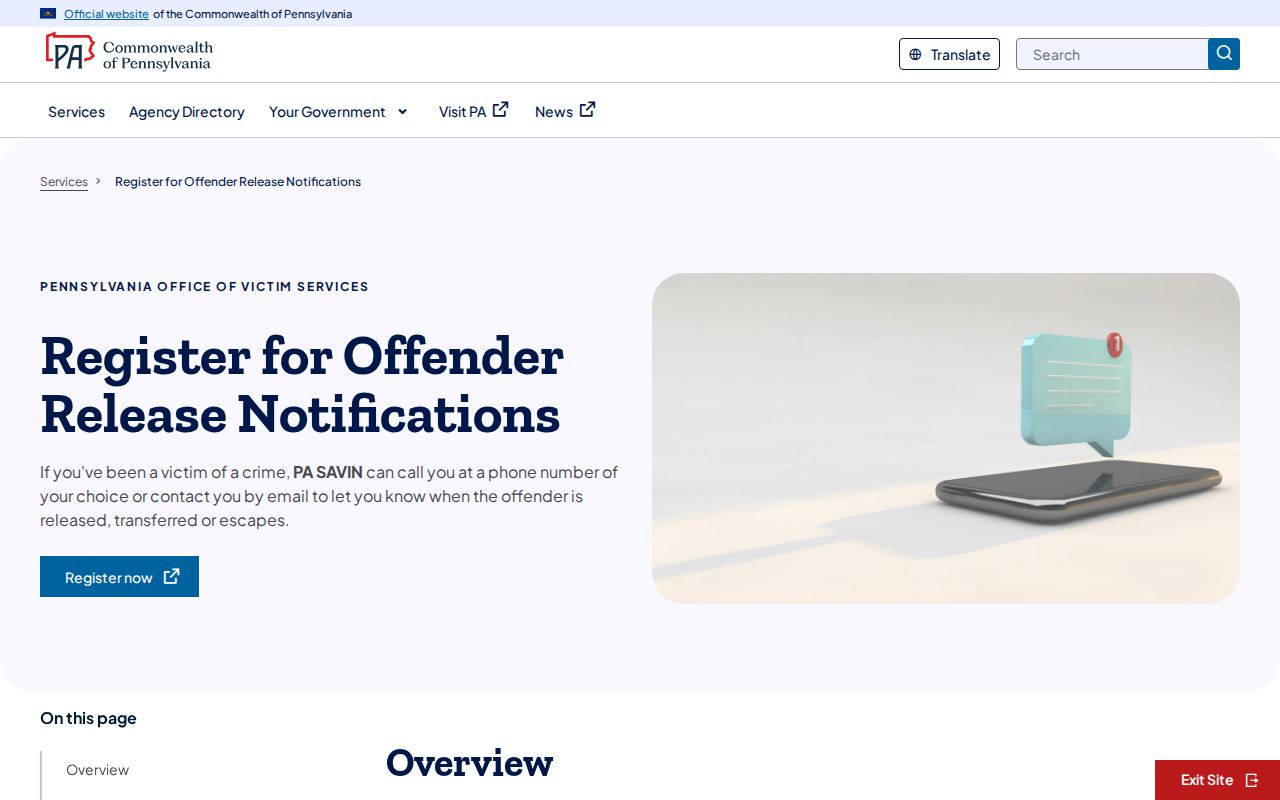
The state guide is the best reference for current registration steps and the warning to maintain a separate safety or verification plan.
Read Allegheny County Release Alerts
The event wording controls the next step. A release update from Allegheny County Jail should be confirmed with ACJ at 412-350-2000. Ask when the person left and whether the destination was release or transfer. This matters because a county departure can lead to personal custody, treatment, electronic monitoring, alternative housing, state custody, or another authority.
- Release
- The participating agency reports that its custody ended. Confirm the destination and actual time with that agency.
- Transfer or movement
- The person changed location or custodial authority. Follow the receiving system.
- Escape
- A custody status event, not a lawful release or discharge.
- No current result
- Only an unsuccessful check at that moment; it does not itself establish release.
A move from ACJ to Renewal or Passages remains a controlled county placement. A move to Pittsburgh CCC, CTC Braddock, Renewal #1, or Renewal #2 may be Pennsylvania DOC community corrections. These settings can permit approved movement but must not be labeled unconditional discharge.
Note: A VINE transfer alert ends one location inquiry and starts the correct receiving-agency check.
Verify Allegheny County VINELink Releases
The official PA SAVIN material warns against relying on VINE alone. Custody data can change quickly, and notifications can lag an agency's underlying event. Treat the notice as a prompt to call or search the authority that owned the transition. Keep the exact event text rather than paraphrasing it into a stronger claim.
For Allegheny County Jail, call the main line and ask the county's two-part question. For a state transfer or state-prison release, use the Pennsylvania DOC locator. Search the supervised-person side when parole supervision is expected. A visible Release Date and parole number can support departure from an SCI into supervision, but they do not prove that the maximum sentence ended or that parole was discharged.
Use UJS Case Search to identify the order, disposition, or sentence behind the event. The docket is not a live door log. An order can precede ACJ processing, and another hold can affect the exit. When durable county proof is needed, request the existing admission or releasing entry with the person's identifiers and a narrow date range.
Is a VINELink release notice certified proof? No. It is a participating agency's notification update. The releasing agency or its record supplies the direct confirmation.
Allegheny County VINELink Coverage Boundaries
PA SAVIN is not the authoritative locator for federal BOP custody or ICE detention. A known federal sentence belongs in the BOP Inmate Locator. BOP results can show a release date and location, including RELEASED or UNKNOWN. A future date is projected, while a past date and no current institution support departure from BOP custody. BOP also warns that another jurisdiction or supervision may continue.
Immigration custody belongs in the ICE Online Detainee Locator. It uses either an A-number plus country of birth or exact name and country details. ICE says ODLS includes current custody and some releases from the prior 60 days. A missing result can reflect lag, spelling, a safety exclusion, transfer, or a release outside that window.
Allegheny's jail policy adds a local limit on inference. A civil immigration detainer or administrative warrant alone does not delay an otherwise authorized ACJ release or impede bond; a judicial warrant is different. Never convert a VINELink release or transfer notice into an ICE handoff unless an agency record identifies that destination.
Allegheny County VINELink Interface Check
The successful manifest capture comes from the official VINELink service and reflects the Pennsylvania search and notification path:
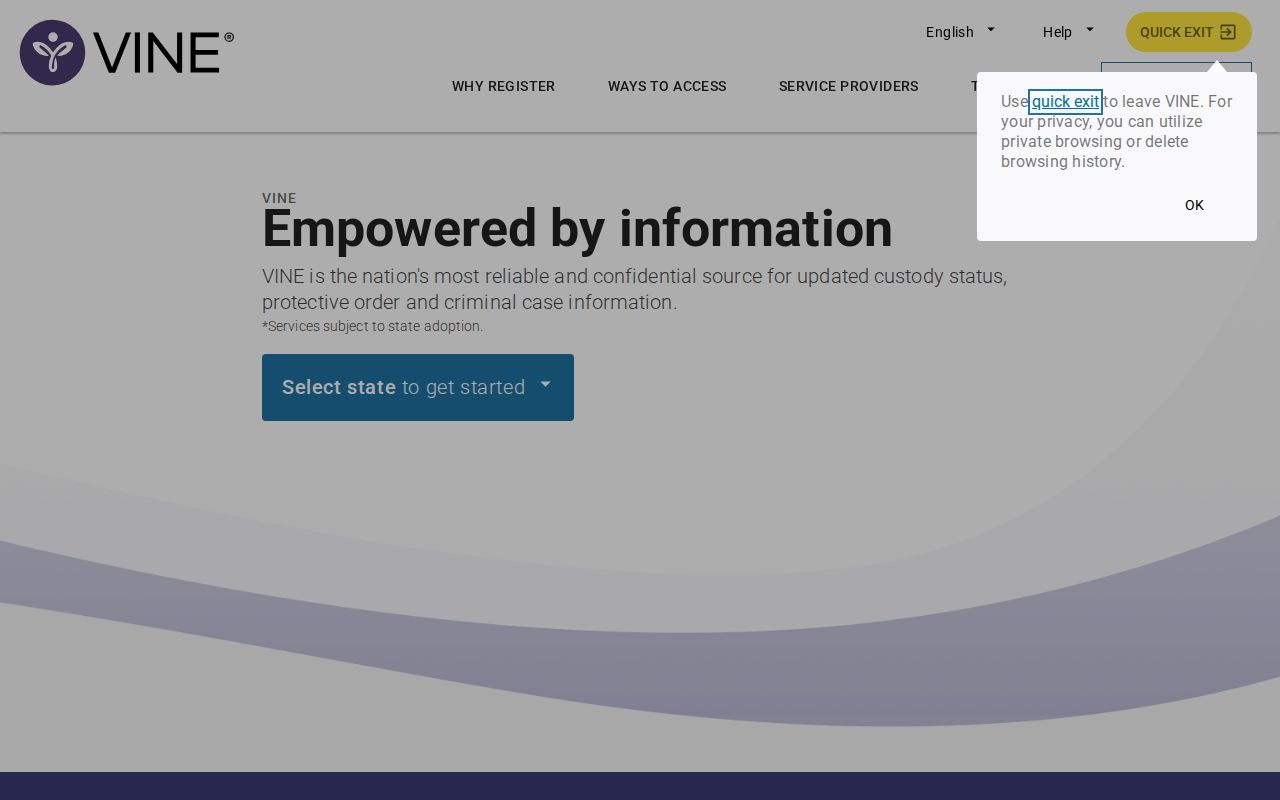
The interface supports person-specific checking and notification registration. It does not create an Allegheny County recent-release feed or certified release certificate.
When a search fails, do a channel check before drawing a conclusion. Confirm that Pennsylvania was selected, compare names carefully, and ask whether the person may be in federal, immigration, or nonparticipating custody. If the person left ACJ for a state institution, the DOC locator becomes the next authoritative view. If ACJ confirms personal release, preserve its date and seek the releasing entry when a record is needed.
Note: One notification can start verification, but only the responsible agency can clarify the event's legal and physical destination.