
RRM Pittsburgh Release Role
Residential Reentry Management Pittsburgh is a federal Bureau of Prisons field office. It manages placements and services in the reentry phase, including residential reentry and home confinement. The office is not a penitentiary, detention center, or county jail. Its downtown suite should never be reported as proof that a person lived there or was held inside that office.
A BOP locator entry tied to a CCM or RRM context can still mean custody. Community placement may allow work, appointments, or other approved movement while the person remains under federal control. Physical presence in the community and legal release from BOP are different facts. The federal result must be read through both its location and date fields.
RRM Pittsburgh also belongs to a different authority chain than Allegheny County Jail, PA DOC community corrections, and county probation. The correct custodian follows the sentence. A federal sentence uses BOP records and the federal docket. A county booking uses ACJ. A Pennsylvania state sentence uses the PA DOC locator. Mixing those systems can turn a transfer or controlled placement into a false release statement.
Find RRM Pittsburgh Release Status
The BOP Inmate Locator is the primary public search. It covers federal inmates released after 1982. A register number offers the strongest starting point because it reduces name confusion. BOP also accepts DCDC, FBI, or INS numbers. A name search can be narrowed with age, race, and sex filters.
- Search by BOP register number when it is known.
- If using a name, enter the full name and apply the available identity filters.
- Open the matching result only after comparing the register number and identifying details.
- Read the release date and location together.
- Treat CCM, RRM, or another community-corrections context as possible continuing BOP custody.
- Use the federal docket when a release order, supervised-release term, or revocation must be understood.
A past release date with no current institution, or a location displayed as RELEASED, supports that BOP custody ended as of the displayed date. A future date is projected and can change. UNKNOWN means BOP has not determined the term. None of those labels promises that no supervision or custody under another authority remains.
When the result points toward community management, avoid treating “RRM Pittsburgh” as a street-level residence. RRM is the administrative office that manages contracted placements and related reentry arrangements. The locator may not identify the person's daily whereabouts in the way a prison name does. That limit is part of the result, not a reason to substitute the county jail roster.
Identity should also be reconciled with the federal docket. A register number and matching case record provide a stronger link than name and age alone. If the BOP location has changed since the docket entry, preserve both dates. One can describe the judicial action while the other describes BOP's later custody status.
Note: Preserve the BOP register number, displayed date, location label, and date checked when documenting a federal release.
Read RRM Pittsburgh BOP Results
The BOP fields serve different functions. The date can be past, future, or unknown, while the location can name an institution, show a community-management context, or state RELEASED. A sound conclusion uses both fields and does not treat a Pittsburgh connection as its own release status.
| BOP result | Meaning for release |
|---|---|
| Past date plus RELEASED | BOP reports the person is no longer in BOP custody on that date. |
| Past date with no institution | Supports departure from BOP custody, subject to the rest of the record. |
| Future release date | A projected federal date that may change. |
| UNKNOWN | BOP has not determined the term shown in the locator. |
| CCM or RRM context | Community placement may still be federal custody. |
BOP warns that release from its custody does not rule out parole, supervised release, immigration custody, or custody in another system. A federal supervised-release term is imposed and administered through the federal process, not Pennsylvania parole. If a federal docket shows a court order, compare it with BOP's actual custody result rather than treating the order date as the exit date.
The official BOP locator is shown in the successful project capture:
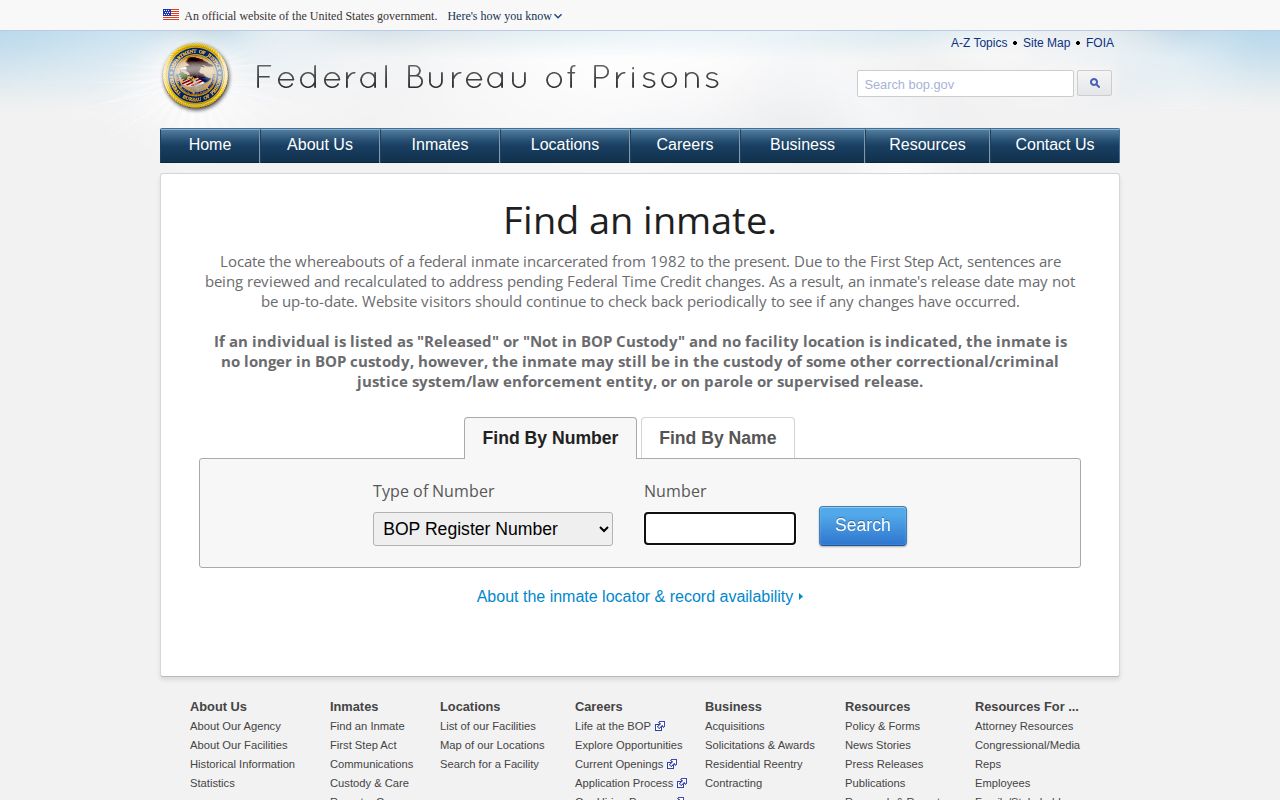
The federal interface provides the date and location fields needed for RRM Pittsburgh release verification.
RRM Pittsburgh Release Contact
The office address identifies the federal administrative unit. It is not a residential-facility address and should not be used to infer where any person stays. The public BOP locator remains the first route for individual custody status. Calls should be framed around the office's role and the correct federal channel rather than an assumption that the person is held in the suite.
Residential Reentry Management Pittsburgh1000 Liberty Avenue, Suite 1315
Pittsburgh, PA 15222
412-395-7930
When the locator result is unclear, the BOP explanation of locator records supplies the field definitions and limitations. Federal court documents can clarify the sentence, release order, supervised-release term, or revocation event. A court entry remains a legal event rather than a live custody update.
Pre-1982 federal releases are outside the BOP locator's coverage and should be pursued through the National Archives. A failed BOP name search therefore cannot support a claim that no federal custody history exists.
RRM Pittsburgh Community Release Custody
Residential reentry and home confinement can look like ordinary community life from the outside. Legal control can still continue. A person may leave an approved residence for permitted work or services and remain accountable to BOP rules. The key question is not whether the person can travel in the community. It is whether the BOP locator and responsible federal record show that custody ended.
- Residential reentry placement
- A structured federal community placement that may remain BOP custody.
- Home confinement
- A community-based setting that can still fall under BOP control.
- Release from BOP
- A locator result supported by a past date and released location context.
- Supervised release
- A post-custody federal court term, distinct from Pennsylvania parole.
A move from a secure federal facility to an RRM-managed setting ends one location but not necessarily federal custody. Conversely, a past BOP release date does not establish that all court obligations ended. Report each milestone on its own terms.
Note: “In the community” describes a place; “released from BOP custody” describes a legal custody event.
RRM Pittsburgh Federal Records
The public locator supplies readily available federal status. The federal docket supplies the judicial record. Use both when a projected date, release order, or supervised-release condition must be placed in context. A future BOP date is expressly projected. It should not be restated as an actual release or imported into the Pennsylvania DOC system.
For a federal pretrial person, the United States Marshals Service may manage custody from arrest or remand until court release, BOP commitment, or return to another authority. No public USMS released-prisoner locator was identified in the research. Use the federal docket for the court order and BOP after commitment. Lack of a Marshals search result proves nothing about release.
When a formal BOP record is needed, begin with the agency's public records explanation and identify the person by register number. Ask for an existing record rather than a new calculation. RRM Pittsburgh's local office identity does not mean it owns every sentence or release document connected to a managed placement.
The Allegheny County custody search helps separate county, state, federal, and immigration routes. The RRM path must stay federal from lookup through conclusion.
RRM Pittsburgh Release Detainer Boundaries
ANGLE K concerns Allegheny County's local detainer rule. ACJ Policy 220 says a DHS Form I-247 civil detainer or I-200 administrative warrant does not by itself delay an otherwise authorized ACJ release or impede bond. A judicially signed warrant is different. That is an ACJ policy. It does not govern BOP, RRM Pittsburgh, or a federal sentence.
For a person leaving federal custody, an immigration question must be checked through the proper federal channels. The ICE Online Detainee Locator accepts an A-number plus country of birth, or exact name and country details. ICE says the system includes current detainees and some releases within the prior 60 days. Absence can have several causes and is not release proof.
Do not infer an ICE transfer from a BOP release date, an RRM placement, or a missing result. BOP departure and immigration custody are separate events. Likewise, ACJ's local policy cannot be used to predict what a federal agency did. Publish an ICE handoff only when an official source identifies it.