
Allegheny County Release Date Meaning
Three dates are often confused. A court order date records legal authority. A computed eligibility or sentence date reflects the judgment and official credit. The actual exit date records when a specific custodian released or transferred the person. They can differ without any record being wrong. Allegheny County Jail begins its own checks after valid authorization arrives, and PA DOC parole requires more than reaching a minimum.
A pretrial detainee has no sentence-based projected date. Bond, dismissal, a new order, or another hold can change custody. For an ACJ stay, call 412-350-2000 and ask when the person left and whether the destination was release or transfer. A sentenced state prisoner has judicial minimum and maximum dates. The minimum is ordinarily the first point when parole can be considered. It is not a promise to leave. The maximum marks the sentence boundary as computed by the responsible authority, subject to the actual judgment and credit.
| Date or event | What it establishes | What it does not establish |
|---|---|---|
| Court order date | The court authorized or imposed an action. | The time ACJ completed processing. |
| Minimum sentence date | Ordinary first parole eligibility for a state sentence. | Guaranteed parole or gate release. |
| PA DOC Release Date | The locator's actual displayed release field. | A universal projected-date label or complete discharge. |
| ACJ exit date | When county-jail custody ended. | Community freedom if the event was a transfer. |
Allegheny County DOC Date Lookup
Use the custody class to pick the source. County-only detainees may never appear in the PA DOC locator. A person transferred from ACJ to a state correctional institution can appear later, even when no operating SCI is in Allegheny County. Former SCI Pittsburgh closed permanently in 2017. State prisoners from the county may be housed anywhere in Pennsylvania, so geography is not a sound filter.
- Confirm state or county custody. Use the court commitment, an ACJ answer, or a reliable DOC identifier.
- Search by number when possible. Enter the inmate or parole number in the Pennsylvania DOC locator; otherwise use name and identity filters.
- Check both relevant views. A former SCI prisoner may remain on the department-supervised-person side after prison exit.
- Copy the labels exactly. Record inmate or parole number, date of birth, current location, and Release Date as displayed.
- Read the docket. Compare the UJS sentence, minimum, maximum, and custody-credit orders.
- Confirm the event. Ask PA DOC about a state transition, or ACJ and the court about a county sentence.
The official interface has been verified to use Release Date. No official Pennsylvania screen labeled “Projected Release Date” or “Tentative Release Date” was found. It is therefore wrong to rename the field. DOC and Parole guidance also states that the exact planned release date is not given to the public, including family and friends. The incarcerated person receives case information through the institutional parole office and may choose to communicate it.
The official PA DOC search form is the source represented in this captured image.
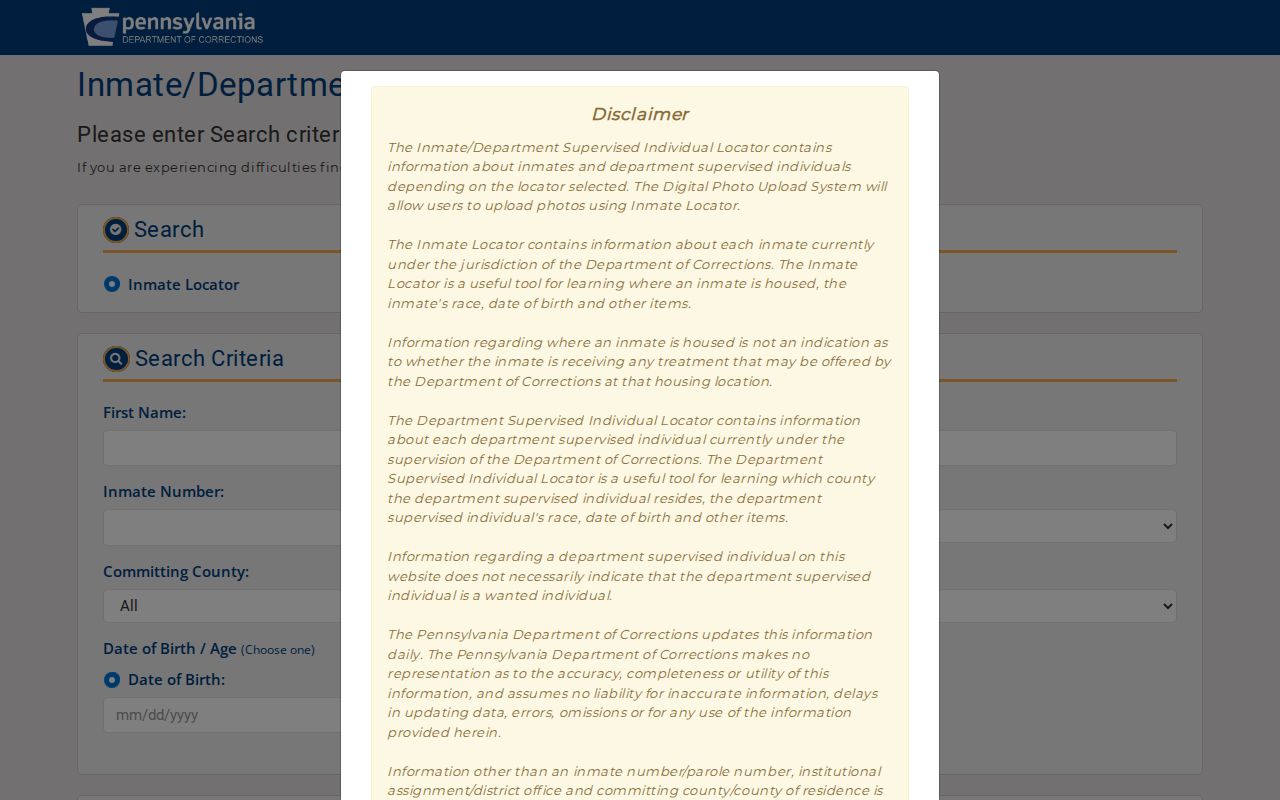
Its fields should be reported as shown, without turning the Release Date label into a promised forecast.
Allegheny County 85 Percent Myth
Pennsylvania does not have a general rule requiring every incarcerated person to serve 85 percent of a maximum sentence. The Pennsylvania Parole Board's official process expressly rejects that claim. There is also no universal good-time percentage that can be applied to a name, arrest date, or public locator result. Any informal calculator built on an 85 percent assumption can produce a false date.
Under 61 Pa.C.S. §6137, the Board generally cannot parole a person before the judicial minimum. It also lacks ordinary parole power over life and death sentences. The minimum creates eligibility, not release. The Board can deny parole, and a grant can remain subject to further steps. Pennsylvania's sentencing structure must be read from the judgment, official computation, and the law that applies to the individual sentence.
- Minimum date
- The ordinary first date of state parole eligibility, unless a valid special program changes it.
- Maximum date
- The endpoint of the imposed sentence as officially computed.
- Custody credit
- Time credited because custody was attributable to the charge, governed by 42 Pa.C.S. §9760.
- Eligibility date
- A point when a person may be considered for release, not a required exit date.
- Parole grant
- Authorization for conditional release once required institutional steps are complete.
County jail cases need their own analysis. Do not apply state RRRI arithmetic to an ACJ booking unless the judgment and statute establish eligibility. Use the sentencing order, official credited time, court or jail calculation, and actual ACJ release confirmation. The full county search and release-record path appears on the Allegheny County released inmates home page.
Allegheny County Sentence Computation
Credit for time served can alter both the minimum and maximum computation. Pennsylvania law at 42 Pa.C.S. §9760 governs credit for custody attributable to the charge. The phrase “attributable to” matters when a person has several dockets, overlapping holds, or another sentence. Counting every day since an arrest can double-count time or assign it to the wrong judgment. Only the official sentence computation resolves that issue.
RRRI, or Recidivism Risk Reduction Incentive, is a separate earlier-eligibility program for a statutorily eligible person. Under 61 Pa.C.S. §4505(c), the RRRI minimum is three-fourths of an ordinary minimum of three years or less. When the ordinary minimum is more than three years, the RRRI minimum is five-sixths, rounded to a whole day. That formula sets an eligibility date. It does not order automatic release, and it should not be used unless the case actually qualifies.
Short Sentence Parole under 61 Pa.C.S. §6137.1 is another distinct route. It applies only to qualifying DOC commitments with an aggregate ordinary or RRRI minimum no more than two years. Enumerated offenses, conduct, warrants, and detainers can exclude a case. Its existence does not support a broad claim that all short sentences end on the minimum date.
| Computation element | Source | Effect |
|---|---|---|
| Judicial minimum | Sentencing order | Sets ordinary first parole eligibility. |
| Judicial maximum | Sentencing order | Sets the outer sentence term, as officially computed. |
| Custody credit | 42 Pa.C.S. §9760 and official calculation | Adjusts dates for qualifying time already confined. |
| RRRI minimum | 61 Pa.C.S. §4505 and qualifying judgment | Creates an earlier eligibility point for a qualified person. |
| Short Sentence Parole | 61 Pa.C.S. §6137.1 | Offers a special process only for a qualifying DOC sentence. |
Why Allegheny Release Dates Change
Reaching eligibility is only one part of the release process. A parole grant still must clear institutional requirements. The official process addresses the minimum date, an approved home plan, release orders, DOC scheduling, and outstanding holds. An in-state home plan is described as valid for 150 days. If the plan fails or expires, a later date may result even though the Board's decision remains part of the record.
| Factor | Possible effect | Source to confirm |
|---|---|---|
| New credit calculation | Moves minimum or maximum when official custody credit changes. | Court and DOC computation. |
| Misconduct or rescission | Can block or withdraw an anticipated parole release. | PA DOC or Parole Board record. |
| Home-plan failure | Delays release until an acceptable plan is approved. | Institutional parole office. |
| Warrant or detainer | Can redirect release to another authority. | Holding and receiving agencies. |
| Another sentence | Continues custody under a separate docket or jurisdiction. | UJS, federal docket, or agency record. |
| Court correction | Changes the judgment or credited time. | Signed order and updated computation. |
“Parole to detainer” is especially easy to misread. It can mean the state sentence changed posture while another authority immediately assumed custody. The person did not necessarily enter the community. Likewise, a location at Pittsburgh CCC, CTC Braddock, Renewal #1, or Renewal #2 can reflect a monitored DOC community-corrections placement. Approved movement does not make it an unconditional release.
Allegheny County Jail Exit Date
ACJ processing follows local operational rules rather than a state-prison forecast. The jail begins discharge after it receives valid authorization and closes or lifts all charges and holds. Its public process allows up to 48 hours beginning at midnight on the date the court or magistrate sends the order. A bond release is described as typically occurring within three hours after ACJ receives the needed documents. These are process windows, not guaranteed appointments or online roster periods.
Call ACJ at 412-350-2000 to ask the question endorsed by the county: when did the person leave and where did the person go? A move to Renewal, Passages, state custody, federal custody, or another county is a transfer or controlled placement, not proof of community release. For durable proof, request the existing admission or releasing entry and ask for the actual exit date and time, destination, transfer agency, or release type if those fields are maintained.
UJS can supply the sentence or release authority. It cannot supply a live door time. If the docket and jail date differ, keep both. The court date describes an order or judicial event. The jail date describes processing and exit. One agency cannot correct the other agency's record.
Confirm Allegheny County Release
A future-looking date should never be published as an actual release. For an Allegheny jail stay, pair ACJ's release-versus-transfer answer with the court order. For state prison, preserve the PA DOC Release Date and supervised status, then ask the assigned parole office what milestone the result reflects. For a federal sentence, BOP alone expressly distinguishes a future projected date from a past date, RELEASED, and UNKNOWN. That federal vocabulary cannot be imported into Pennsylvania's locator.
PA SAVIN or VINELink can send participating county, state-prison, and state-parole status notices. A move notice may mean transfer. It is not a certified release record. The Allegheny County VINELink release check explains the person-specific registration path. After an alert, confirm the event with ACJ, PA DOC, or the named destination agency and note the time checked.
If a computed date is not public, a Pennsylvania DOC Right-to-Know request can seek an exact existing record or field using the inmate number. It cannot require DOC to create a new forecast or reveal protected institutional-plan material. The DOC Right-to-Know Law Office is at 1920 Technology Parkway, Mechanicsburg, PA 17050; 717-728-7763; RA-docrighttoknow@pa.gov.