
Allegheny Mugshot Nondissemination Rule
Allegheny County and the Allegheny County Jail state that they do not disseminate mugshots to noncriminal-justice agencies. That position is not just the result of a missing gallery. The Pennsylvania Supreme Court has treated booking photographs as identifiable descriptions within criminal-history-record information under the Criminal History Record Information Act, commonly called CHRIA. A county acting outside a law-enforcement role could not release those photographs as routine public copies.
This current rule displaces older, generic claims that every Pennsylvania booking photograph is an ordinary public record available on demand. The Pennsylvania Right-to-Know Law still lets a requester ask an agency to make a formal determination about a specific existing record. It does not create a dependable mugshot channel, override CHRIA, or guarantee a copy after payment. Allegheny's policy must be the starting point for any county booking-photo request.
An authorized police publication is different. CHRIA allows law-enforcement dissemination when it is authorized and needed for a law-enforcement function. A public-safety bulletin may therefore carry an image. That limited publication does not create a universal archive or show that the person was later released. Context, date, and agency purpose must remain attached to the image.
Allegheny Released Mugshot Channels
A photo search should follow the authority that owned the custody record. ACJ is the source of a county booking photo, but its nondissemination rule makes public delivery uncertain. PA DOC may show an available image for a person in state prison or under department supervision. A police release or established news report may preserve a photograph that was lawfully issued for public safety. Each channel has a different scope and none replaces release confirmation.
| Channel | Photo availability | Correct use |
|---|---|---|
| Allegheny County recent-release gallery | None located | Do not infer a roster or photo archive from aggregate jail data. |
| ACJ records request | Legally constrained and not dependable | Request a formal decision separately from non-photo release fields. |
| PA DOC locator | May display an available state image | Match the inmate or parole number and current state record. |
| VINELink or PA SAVIN | Not a promised photo archive | Use for participating custody status and notices. |
| Authorized police publication | May contain a photo | Keep the public-safety purpose and publication date. |
| Established news report | May preserve an issued image | Treat it as dated reporting, not live custody proof. |
| Unofficial commercial page | May be stale or misidentified | Do not rely on it as an official release record. |
No official Allegheny sheriff app with a released-person photo view was found. VINELink's mobile app is a Pennsylvania notification channel, not a county mugshot gallery. Communications and account tools used by people in custody are not release-photo feeds either. Naming those limits prevents an app icon or third-party interface from being mistaken for an official county product.
Allegheny DOC Release Images
The Pennsylvania DOC locator can show an available photograph for a state inmate or department-supervised person. Search by inmate or parole number when possible. If only a name is available, compare date of birth, identifiers, current location, and the image before deciding that the record belongs to the same person. A name and face alone are weak links when names are common or images are old.
The state locator is not an Allegheny County booking archive. A county-only jail stay may never appear there. Conversely, someone convicted in Allegheny County may be housed at an SCI elsewhere because Former SCI Pittsburgh closed in 2017. A supervised-person entry with a Release Date and parole number can support departure from a state prison into supervision. It does not establish that all correctional supervision ended.
The official Pennsylvania DOC locator is the proper source for the state image channel shown below.
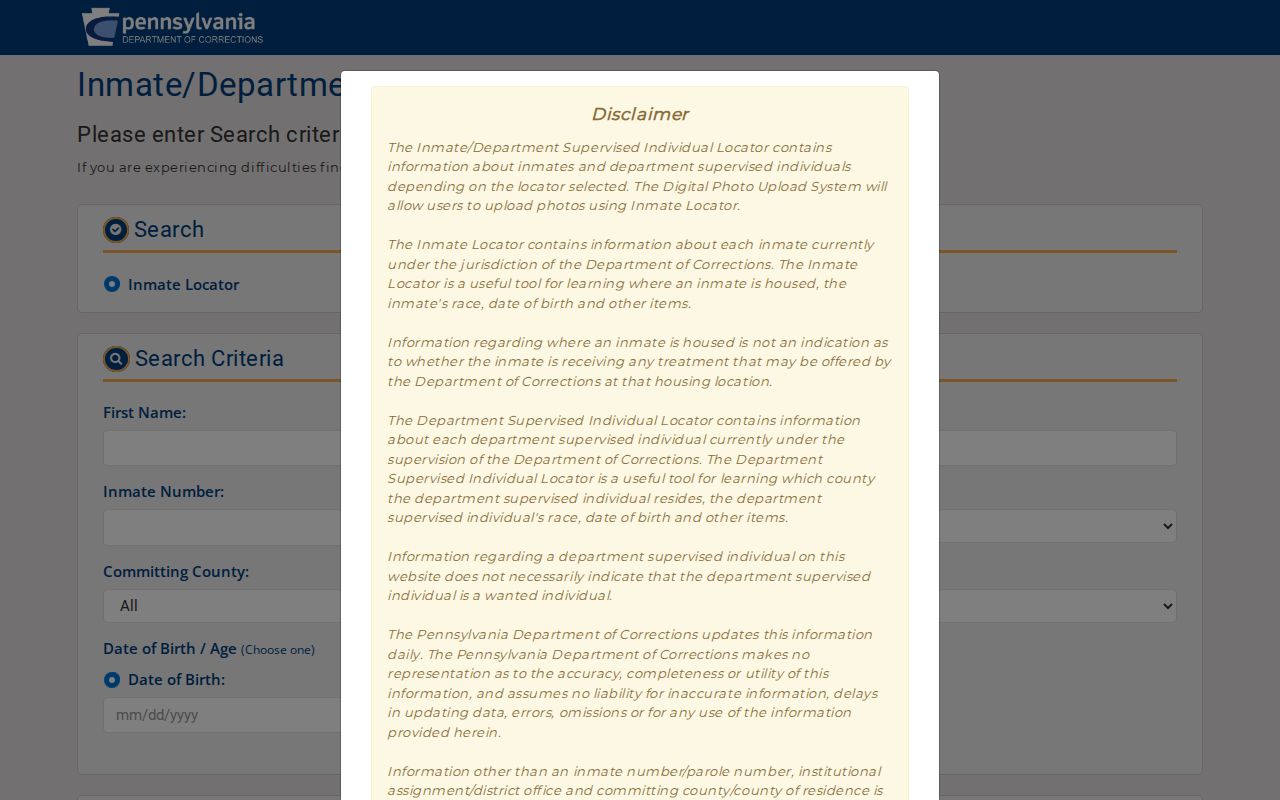
The screenshot represents a state search interface, not a gallery of Allegheny County jail releases.
- Choose the inmate or department-supervised-person route that fits the known status.
- Search by inmate or parole number before using name filters.
- Compare identifiers and current location, not the picture alone.
- Record the exact Release Date label if the result shows one.
- Confirm any claimed release through PA DOC or the assigned parole office.
Requesting Allegheny Booking Photos
A narrow records request can seek an agency's formal determination, but it should not promise delivery. Separate the photograph from the admission and release fields. If the photo is denied under CHRIA or county policy, that decision should not hide a potentially available release date, exit time, destination, or transfer-agency field. Ask only for existing records and give one booking plus a date range.
- Identify the record. Supply the full name, date of birth if known, booking or control number, ACJ, and the approximate booking range.
- Separate the requests. Put the booking photograph in its own numbered item, apart from routine booking and releasing data.
- Acknowledge the rule. Ask the county to issue its formal determination under current ACJ policy and CHRIA.
- Choose electronic delivery. This normally avoids an added delivery fee when disclosure is granted.
- Read the response. A partial denial should state its legal grounds and appeal information; an extension must identify the statutory reason and response date.
Allegheny County's Open Records Officer is Jessica Garofolo, County Office Building, 542 Forbes Avenue, Room 101-Mezzanine, Pittsburgh, PA 15219. Requests can go to openrecords@alleghenycounty.us; 412-350-6109; fax 412-350-4925. The county generally must grant, deny, partially deny, or issue a valid extension notice within five business days under the Right-to-Know Law.
Paper copies are listed at $0.25 per page or side, certification at $1, plus actual postage and allowed reproduction costs. Those fees do not buy a legal right to a mugshot. No payment should be sent unless the agency instructs it. A duplication charge and a disclosure decision answer different questions.
Verify Allegheny Mugshot Identity
A mugshot records an image at one point in a criminal-justice process. It does not show whether the case ended in acquittal, dismissal, conviction, parole, or another disposition. It does not show the instant ACJ custody ended. An old photograph can remain in reporting after a new court order, a transfer, or a later change to public access.
For county custody, call ACJ at 412-350-2000 and ask when the person left and whether the destination was release or transfer. Check UJS for the order or disposition. Request the existing releasing entry when documentary confirmation matters. For a state sentence, use PA DOC's Release Date and supervised status. For federal custody, BOP's location and date are authoritative. Those custody sources should lead; the photo follows them.
| Claim | Best confirming source | Why the image is insufficient |
|---|---|---|
| Released from ACJ | ACJ answer or releasing record | The booking photo has no exit event. |
| Transferred from ACJ | ACJ destination plus receiving agency | A county image cannot show later custody. |
| Released from an SCI | PA DOC Release Date and supervision record | The state image can persist after prison exit. |
| Case disposition | UJS docket or filing court | A photograph does not state the judicial outcome. |
The Allegheny County released inmates search path combines those official channels. An unofficial page can be used only as a lead to locate an official record. It may confuse people with similar names, retain a stale image, or omit the fact that public access later changed.
Allegheny Mugshots After Expungement
An Allegheny County expungement is not an instant, single-database switch. The Department of Court Records says that after a Common Pleas order it removes responsive nonconviction data from physical and electronic files and gives notice to a long list of agencies. That list includes ACJ, the Sheriff, Adult Probation, Pennsylvania State Police, the District Attorney, the arresting agency, and other justice offices.
Implementation may take up to one year. During that period, two official systems can disagree. Later absence from public UJS search may reflect expungement or limited access, but absence alone is not a certificate that a booking never occurred. Clean Slate limited access under 18 Pa.C.S. §§9122.2 through 9122.3 also hides qualifying categories after the applicable conditions and periods. Limited access and expungement are distinct legal results.
An outside publisher may retain an old image after the official record changes. No enacted statewide Pennsylvania anti-pay-to-remove mugshot law was verified in the research. House Bill 1585 in the 2025–26 session was proposed legislation, not current law. Do not describe it as enacted, recommend a removal vendor, or assume a fee can force every copy off the internet.
Why Allegheny Mugshots Stay Limited
Allegheny's policy and the Pennsylvania Supreme Court's CHRIA analysis explain the absence of a routine county photo fallback. A mugshot is an identifiable description tied to criminal-history-record information, not just an ordinary portrait. That classification changes the access analysis even when basic booking or release fields may be handled differently. Each record must be assessed by its custodian.
Police may still release a photograph for an authorized public-safety function. Established reporting may preserve that issued image. Neither event creates a complete, official released-person gallery. The date, source, stated purpose, and custody event should stay with any reference to the image. A cropped photo without those facts can distort identity and status.
Dignity and accuracy point in the same direction. Use an image only when it helps identify the correct official record, and do not treat appearance as evidence of conduct, guilt, current custody, or release. When records conflict, state the conflict and ask the office that created each record to clarify its own entry.